In 2024, the UK’s Labour government announced plans to ban conversion practices – sometimes called “conversion therapy” – in England and Wales.
In June 2026, a draft version of this law was published. It isn’t law yet. It still has to be checked over and agreed before it can come into force.
Many LGBTQ+ people will be familiar with the concept of conversion practices, and why they’re so damaging – because no one should be punished or shamed for who they are.
But many wrongly believe that conversion practices are a thing of the past. You might be surprised to learn how pervasive they still are.
Read our guide to conversion practices to understand more about what they look like, why they’re so incredibly harmful, and how to offer your support to the UK ban.
Please note: this guide is for general information and support. It seeks to reflect the law as proposed at the time of writing (14 September 2026) and isn't legal advice. The draft Conversion Practices Bill is still going through Parliament and may change. For advice about your own situation, please contact a qualified professional.
Conversion practices: a summary
Some people might understandably find this page upsetting to read. We’re offering a short summary here so you don’t have to go through the whole guide.
Here’s what you need to know:
- Conversion “therapy” is now known as conversion practices.
- Conversion practices are any treatments or services that attempt to change or suppress your identity.
- All conversion practices are harmful, because they’re based on the ideology that being LGBTQ+ is wrong.
- Trans+ people and asexual people face higher risks of being offered or undergoing conversion practices.
- A draft law has been published to ban conversion practices in England and Wales, but it is not law yet.
- If you’ve experienced or are experiencing conversion practices, or are worried that you might, you can get support from Galop.
What is “conversion therapy” (or conversion practices)?
“Conversion therapy” is a term for any kind of practice that targets LGBTQ+ people with attempts to change their sexuality or gender identity.
Although it’s widely known, the phrase “conversion therapy” is no longer used to describe this abusive treatment, because it is misleading to call it therapy.
There is nothing therapeutic about being pressured to change or hide who you truly are.
The preferred term is “conversion practices”.
Ban Conversion Practices is a coalition of organisations and mental health practitioners who campaign to ban these harmful practices. The coalition includes Stonewall, Amnesty International, and the LGBT Foundation.
It defines conversion practices as:
“...treatments, practices or services that seek to change or suppress a person’s sexual orientation, gender identity or gender expression, based on the assumption that any sexual orientation, gender identity or gender expression is inherently preferable to any other.”
What conversion practices might look like
Conversion practices can come in many different forms.
Some are overtly violent and harmful. Others may be more subtle, disguised in therapeutic language and promises to help you.
But all conversion practices are underpinned by the same hateful ideology: that it is better to be straight, or cisgender, than to be LGBTQ+.
Below are some examples of what conversion practices may look like.
Note: this list could be distressing to read for some. Take your time, and notice how you’re feeling – if you need to take a break from this page, please do.
Conversion practices may take the form of:
- Talking therapy.
- “Accountability” groups.
- Prayer and faith-based practices.
- Mentoring or coaching.
- Pressure, manipulation, and shaming from family or community members.
- Torture methods.
- Physical or sexual assault.
Conversion practices might take place in formal settings like healthcare or faith institutions, or more informally in your community.
They are often disguised as legitimate medical, therapeutic, or faith-based interventions.
This is one reason the draft Bill sets a high bar and keeps regulated healthcare and therapy outside its scope, unless the conduct falls far below accepted professional standards.
No matter how the message is delivered, it is extremely damaging to be encouraged to change your sexuality or gender identity.
Why conversion practices are so harmful for LGBTQ+ people
Over 25 health, counselling, and psychotherapy organisations, including NHS England and the Royal College of GPs, have signed a joint statement saying that conversion practices are “unethical, potentially harmful, and… not supported by evidence”.
Human rights and LGBTQ+ organisations have gone even further, with Amnesty International saying these “abhorrent” practices “can constitute torture or cruel, inhuman and degrading treatment and should be stamped out now with no excuses”.
No matter how conversion practices are carried out, they send the message that LGBTQ+ people are “broken” and need to be “fixed”.
They can intensify mental health issues, adding to distress, trauma, and internalised shame and homophobia/transphobia.
All of us deserve to live freely as our authentic selves, without pressure to change, and without the threat of exclusion or punishment.
Are conversion practices still happening?
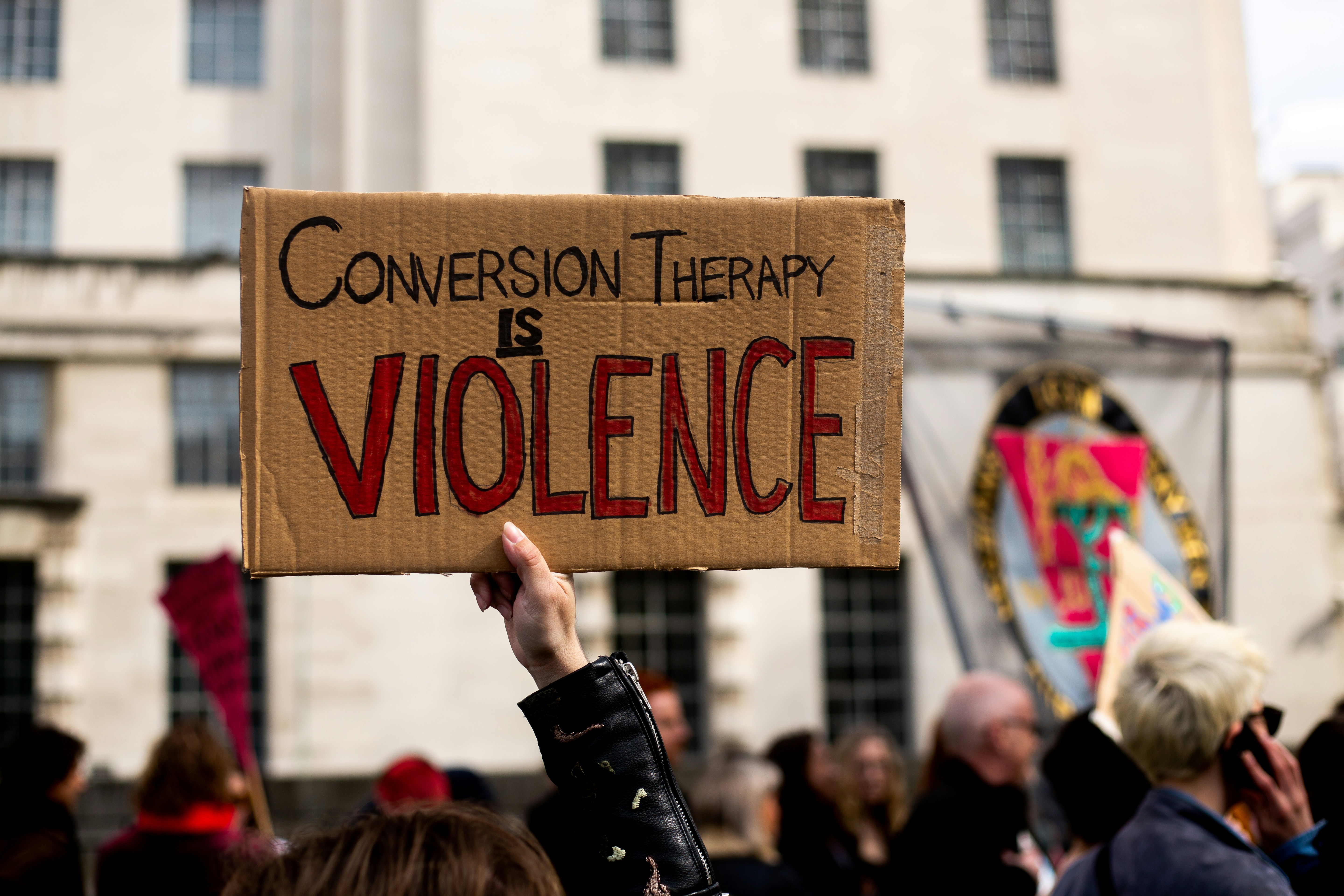
Yes. Conversion practices are not relegated to the distant past – they happen today.
A UK government survey in 2018 found that 5% of LGBTQ+ people had been offered conversion “therapy”, and 2% had been through it.
Trans+ respondents were almost twice as likely to have been offered or undergone conversion practices, at 13%. Asexual people also faced a higher risk, at 10%.
A study by the LGBT+ anti-abuse charity Galop, carried out between 2022 and 2025, looked into 195 cases of conversion practices.
68% of these cases were currently happening, recent, or ongoing.
8% of the cases analysed involved “psychological” or “medical” interventions, perpetrated mainly by therapists and psychiatrists.
This is a real problem facing LGBTQ+ people today.
What’s going on with the UK conversion practices ban?
The UK government first promised to introduce a law to ban conversion practices in England and Wales back in 2018.
The Conservative government held public consultations on a potential ban between 2021 and 2022, but failed to create an actual Bill to make the ban become law.
When Labour came into power in 2024, they promised to publish a Bill to finally ban conversion practices.
Their draft Bill was eventually published in June 2026. After so many years of discussing the ban without concrete steps being taken, this was met by campaigners with relief and celebration.
Galop called the draft Bill a “vital first step” towards a ban that is so “urgently needed”.
Stonewall said it was a “historic and long overdue step forward”.
But, as both organisations named, this is just a step – there is still more of the journey to go.
What does the draft conversion practices ban say?
The draft law would make the most serious conversion practices a crime, with up to five years in prison.
It would also let courts step in to protect someone before anything has happened, in the same way they can with forced marriage.
It names non-binary people directly, and covers asexual people too.
Not everything in this guide would be covered by it. The law sets a high bar, and treats healthcare settings differently.
This doesn't mean there's nothing you can do right now. A lot of what happens in conversion practices is already against the law.
If something is happening to you, or you suspect it might, it’s worth seeking support. Find out more about Galop’s Conversion Therapy Support Service.
When will the conversion practices ban become law in the UK?
The Bill still needs to be scrutinised and to pass through Parliament to become law in England and Wales.
Meanwhile, Scotland held public consultations on the introduction of a ban in 2024, but has not yet drafted a Bill to outlaw conversion practices.
A Private Members’ Bill proposing a ban on conversion practices was also introduced to the Northern Ireland Assembly in June 2026. The Bill needs to pass through the necessary legislative stages before March 2027 to become law.
How to support the campaign for a conversion practices ban
The Ban Conversion Practices coalition is a great source of information. You can follow them on social media, and sign up to their mailing list for updates, to find out how to support their campaign.
Stonewall has some more suggestions for how to get involved, including:
- Learning more about conversion practices.
- Sharing your story.
- Spreading the word on social media.
If you’re in England or Wales, you can share your thoughts on the draft conversion practices ban and why it matters with Ban Conversion Practices.
In Scotland, you can write to your MSP to share your support for a conversion practices ban. Find your MSP here.
In Northern Ireland, you can share your views on the Conversion Practices (Criminalisation) Bill.
What is LGBTQ-affirming and gender-affirming therapy?
If you’re looking for a therapist to talk to about your identity, all LGBTQIA+ people could benefit from working with an LGBTQ-affirmative therapist.
LGBTQ-affirming therapists are well-informed and non-judgemental when it comes to LGBTQIA+ identities.
They may be part of the community themselves, or enthusiastic allies, able to offer a space where you can be yourself without discrimination or shame.
Gender-affirming therapists offer the same unconditional support for trans+ people.
LGBTQ-affirming and gender-affirming care are not conversion practices. They offer you the space to discover and accept who you are.
LGBTQ-affirming and gender-affirming therapists aren’t working to a predetermined outcome. They practice ethically, which means they have proper knowledge of gender and sexual diversity, and they don’t treat any identity as preferable to another.
That means not pushing you towards an identity, in any direction.
They simply offer open-minded and empathetic support as you work out your identity for yourself.
This is different to those who deliver conversion practices, where the goal is to change your identity.
No good therapist should ever try to change who you are. The only person who gets to shape your identity is you.
Find out more about LGBTQ-affirmative therapy.
If you’re experiencing, or have experienced conversion practices
If you’ve been subjected to conversion practices, you deserve support.
You don't have to work out whether it counts as conversion practice before you reach out.
Galop's Conversion Therapy Support Service is free, confidential and staffed by LGBT+ people: call 0800 130 3335, email help@galop.org.uk, or live chat at conversiontherapysupport.org.uk. You can use this service whether it’s happening now, happened in the past, or you're worried it might.
Galop's national helpline for LGBT+ victims and survivors of abuse and violence: 0800 999 5428.
If you're under 18, or living with the people doing this, or financially dependent on them, you can still get support. You don't need to have left, and you don't need a plan.
Get LGBTQ-affirmative wellbeing support with Voda
Voda is the LGBTQ-affirming mental wellbeing app that's built by us, for us.
You can use it to discover self-care practices to support you in your journey of accepting yourself and building a thriving queer life.
Because in a world of minority stress, we deserve a healing space that’s just for us.